Showing posts with label food. Show all posts

Thursday, 7 January 2016

Happy New Year Everyone!

Happy New Year everyone! I hope that 2016 is a brilliant year for everyone. In Japan, New Years Day is one of the most important celebration in the year. Here is a fact file on New Years Day.


  • New Years Day lasts for 3 days
  • In Japan, a special meal is made called osechi and the idea is that you eat it for the three days but recently, you can buy osechi and it is not always eaten for the three days.
  • Along with the osechi, there is a soup called ozōni.
  • The ozōni contents can vary, for example our ozōni contained chicken, rice cake and a decorative fishcake
  • Most parts of the osechi represents prosperity, good health and health
  • Presentation and colour is very important in osechi ryouri
Here is a description of some of the components in the osechi that we had this year


Our osechi ryouri
1. Kamaboko- a dense cake of fish cake in the colors of New Years Day (red and white)
2. Kobumaki- some salmon wrapped in konbu and tied together with a ribbon of gourd.
3. Datemaki- An egg and fish paste roll that is quite sweet.
4. Gomame- Small dried fish (we used dried anchovies) which is covered in a sweet sauce that is made
                     out of sugar, miring, sake and soy sauce.
5. Kurogoma- Black beans boiled in a sweet sauce.
6. Kurikinton- Made out of candied chestnuts and Japanese sweet potato.
7. Namasu- Grated carrot and daikon radish pickled in sweet vinegar.
8. Chikuzeni- Simmered chicken and vegetables
9. Kazunoko- Crunchy herring roe which is sometimes marinated in soy sauce, sake and dash
10. Kanten- Agar jelly containing milk and peach slices
11. Ozoni- A soup containing rice cakes and sometimes a decorated fish cake which has a spiral in it.

I hope that you had a brilliant New Years Day. Goodbye 2015 and hello 2016!

Thursday, 31 December 2015

New Years Eve in Japan

Here in the UK, you don't really so much for New Years Eve apart for staying up until midnight. However in Japan, New Years Day is a very important time.

New Years Eve

  • The japanese word for New Years Eve is 大晦日 (ōmisoka)
  • Running up to this day, people will be cleaning their houses. This is to purify the house and welcome the God of the Coming New Year who is called 年神様 (toshigami-sama)
  • Some people decorate their houses for New Years Day. I made an origami wreath and some origami decorations
New Year's day wreath


Kadomatsu 門松

Not many people in Japan set up a kadomatsu because of the lack of space outside of the house. It is seen as just a decoration. However, I have found some information on how and when you should set up a kadomatsu if at all possible. 
  • This is a decoration made out of bamboo sticks and pine branches.
  • The kadomatsu is placed in front of the house to welcome spirits and Toshigami-sama into the house
  • You must set the kadomatsu up or the god Toshigami-sama will not enter the house and bring happiness
  • The word literally means pine gate (門-gate 松-pine)
  • You should not set it up on the 31st December because it is impolite and implies that you have rushed through the process and finished it at the last minute
  • Also you should not set it up on the 29th December because it is considered an unlucky day
  • You can take the decorations down from the 7th January. However, you should'nt take the decorations down before then because Toshigami-sama stays until the 7th so it would be considered impolite
Kadomatsu
By Nesnad (Own work) [CC BY-SA 3.0 (http://creativecommons.org/licenses/by-sa/3.0)], via Wikimedia Commons

Kagamimochi 鏡餅
  • Kagamimochi is a decoration made out of two rice cake balls and an orange. The largest rice cake ball goes on the bottom, then the smaller rice cake ball goes on top and then finally, the orange goes on the top.
  • The name literally translates as Mirror rice ball because it looks like an old round hand mirror.
  • They are supposed to be placed around the house, each area of the house has a corresponding Shinto God.
  • You can easily buy kagamimochi covered in plastic from the supermarket. It needs to be protected with plastic otherwise it spoils easily.
  • On the 11th January, you can eat it. This day is called the Kagami biraki which literally means openening the mirror
  • The mochi is then broken and eaten in a soup.
Kagamimochi
By Juni from Kyoto, Japan (Flickr) [CC BY 2.0 (http://creativecommons.org/licenses/by/2.0)], via Wikimedia Commons

Toshikoshisoba 年越し蕎麦
  • This is the food that is eaten on the day before New Years day
  • Buckwheat noodles are usually eaten hot on this day but the toppings can vary.
  • What my family has is vegetables and prawns fried in tempura.
The toshikoshi soba that we had
I hope that you have a brilliant New Year! Goodbye 2015, Hello 2016!


Friday, 25 December 2015

Christmas in Japan-Food

The food is one of the things that people look forward to at Christmas. And Japan is no exception.

Food

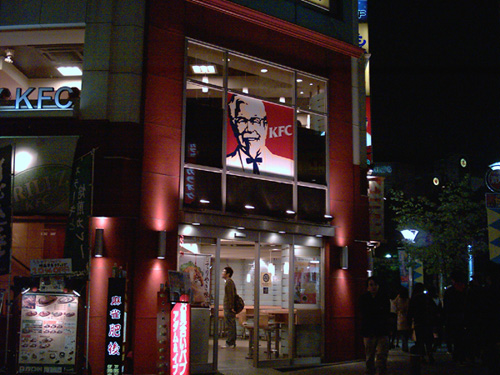
  • As most Japanese kitchens do not have ovens, Japanese people do not have turkeys at Christmas. The largest oven that people would have would be an oven toaster. Instead, they have a chicken dinner from KFC
KFC store in Ikebukuro
By kici (-) [Public domain], via Wikimedia Commons

  • This is because, in the 1970's, a customer in KFC's Aoyama store supposedly mentioned how there was no turkey available in Japan so fried chicken was the next closest thing at Christmas. 
  • Which led to an advertising campaign called 'Kentucky for Christmas. This was a huge success in Japan which also started the tradition of having Kentucky Fried Chicken for Christmas
  • Every Christmas, there are huge queues outside shops and some people also reserve food so they do not miss out.
  • Also Japanese people have Christmas cake as well.
  • It is usually a sponge cake covered in cream and strawberries. Occasionally it can be a Yule log.
  • The Christmas cake is a symbol of commercialism and prosperity. 
  • In World War 2, American soldiers helped to rebuild Japan. The economy was is a desolate state and food shortages were common.
  • To help the people, sweets were handed out by the American soldiers. Sweets were considered a  luxury to the people
  • Japan then embraced an American Christmas.
  • Sponge cakes could have been made since the 17th century but the sugar, butter and milk were considered a luxury
  • After the war, the economy improved and these ingredients became widely available for people to make sponge cakes
  • The colours are symbolic, red and white reflect the colours of the Japanese flag.
  • This is a picture of the yule log that I made for Christmas this year.

Fun fact: There is even a Christmas sponge cake emoji!
Christmas sponge cake emoji

The next big event for Japanese people in New years eve and day. I will be uploading posts about them soon! メリークリスマス!


Saturday, 26 September 2015

Wagashi (traditional Japanese sweets)

One thing that is very beautiful, delicious and Japanese is wagashi. Now, you're probably wondering what on earth wagashi is. Well, as written in the title, wagashi is a traditional Japanese sweet. It is often eaten with a cup of green tea and often reflects the season that it was made it. So, for example, wagashi made in autumn may have autumnal colours or shaped like a leaf.

Making wagashi is considered an art. Wagashi evokes the seasons and landscapes of Japan and appeal to all of the senses. The appearance will appeal to sight, the scent to smell, handling of the sweet to touch, the musical name which sometimes is associated with the seasons and of course, the taste of it.

There are many types of wagashi. Here is a list of some of my favorites;

  • Anmitsu (Chilled jelly-like cubes with fruit and sometimes a sweet syrup)
Anmitsu with azuki paste, black syrup and green tea
  • Amanatto (Sugar coated beans)
  • Dango (Mochi balls skewered on a stick)
Coloured dango
By gochie* (花より・・・) [CC BY 2.0 (http://creativecommons.org/licenses/by/2.0)], via Wikimedia Commons

  • Dorayaki (Two small pancakes containing azuki bean paste)
  • Dorayaki
    By Ocdp (Own work) [CC BY-SA 3.0 (http://creativecommons.org/licenses/by-sa/3.0)], via Wikimedia Commons
  • Kuri kinton (Sweet chestnut paste)
  • Taiyaki (A fried waffle containing azuki bean paste)
Taiyaki
By ProjectManhattan (Own work) [CC BY-SA 3.0 (http://creativecommons.org/licenses/by-sa/3.0)], via Wikimedia Commons
  • Yokan (A solid block of azuki bean paste, solidified with agar and sugar)

Recently I have been trying some different wagashi. One of them is called 甘納豆 (amanatto) or sugar coated azuki beans.

It came in this really pretty box

The contents

Daifuku bean

Azuki beans with a cup of green tea

Uguisu beans

Opinion: They were sweet but not too sweet and were absolutely delicious with some green tea. Unfortunately, you cannot buy amanatto in the UK so if you are in Japan, definitely try and find some because they are delicious.

Also, I tried some yokan too.

Here is the box

Once you remove the paper packaging, this is what it looks like

Once you open the box, this is what the yokan packaging looks like

I only tried the honey flavored yokan

And this is what yokan looks like
Opinion: I found it very tasty, it was sweet but not unbearably sweet. I would compare it to a really hard jelly baby. Green tea really goes well with it.

So if you are around in Japan, go and try some wagashi. I recommend the Toraya shop in Ginza and the number of shops in Asakusa.

Sunday, 20 September 2015

Autumn in Japan

So, it's that time of year again. People go back to school, work and trees put on a spectacular show before it's winter. Japan is no exception. So I thought that I could start writing an overview about autumn in Japan

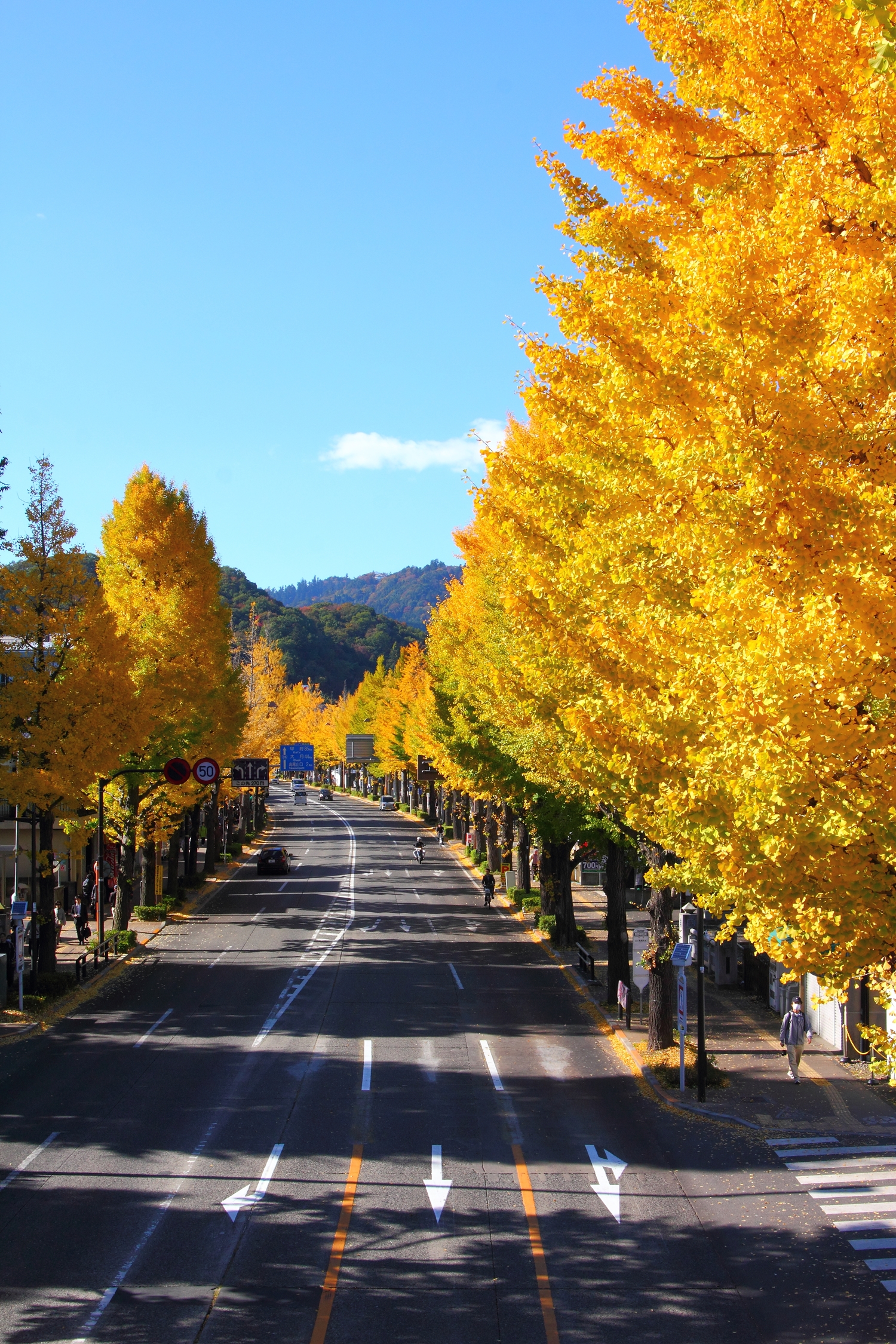
Because of Japan's north-south extension, you can see the leaves changing colour and falling over three months. Hokkaido is the first to feel the effect of the autumn. The leaves here start changing from mid September to late October. The warmest areas of Japan like, Okinawa feel the effect of autumn last as it is one of the warmest places in Japan.
Hachioji (Tokyo)
By Kakidai (Own work) [CC BY-SA 4.0 (http://creativecommons.org/licenses/by-sa/4.0)], via Wikimedia Commons

After the long, hot humid summer, autumn is a welcome sign that the temperature will cool down considerably. Temperatures become more comfortable, which is probably one reason that the most popular season in Japan is autumn. A really good place to see the leaves change colour in Tokyo is Meiji-jingu temple in Shinjuku. I will put details on how to find it at the bottom.

Nature, being an integral part of the Japanese culture can be enjoyed everywhere. You can go to places of historical importance to walk through while taking in the colours of the ginko and maple trees.

Food is also an important part of the Japanese autumn. Matsutake mushrooms are being used very often in cooking as they are in season. Most foods are in season so there is a variety of food that you can eat. Delicious fruit such as Japanese pears, persimmons and chestnuts are also in season. You can find them in asian supermarkets and occasionally normal supermarkets. If you find some, I highly recommend that you try it. You will definitely find them in Japanese supermarkets. I might put a few autumn recipies in my next posts.

So if you are around in Japan in the autumn, enjoy the most popular season! Leave a comment about your experiences of a Japanese autumn!

Where to find places;
Meiji jingu temple: Just behind the JR Harajuku station.


Tuesday, 1 September 2015

Have a break, read about the Kit Kat!

The Kit Kat was invented in York, England in 1988 and popularised around the world. Some countries enjoyed them so much, so they developed flavours that would appeal to the people in that country. One country that did that was Japan!

Fun fact: When you say Kit Kat in Japanese, it sounds like kitto katsu, which means 'you will probably win'. Kit Kats are very popular gifts for students taking important exams.

Japan is particularly famous for their more unusual flavours of Kit Kat. Here is my list of some on the flavours. I would name them all but there are more than 200 flavours but I will name a few.

Mango
Strawberry
Passion fruit
Pineapple

Here are some more unusual ones;

Sweetcorn
Salt and caramel
Potato
Green tea
Pumpkin
Espresso
Ramune
Wasabi

And here are some REALLY unusual flavours;

Chestnut
Red bean soup
Black sugar
Ginger ale
Blueberry cheesecake
Soy sauce

And in England, they have;

Orange
Dark chocolate
Mint
White chocolate
Cookies and cream
Original

When it comes to flavours, Japanese manufacturers really do not limit themselves at all!
Leave a comment about your favorite flavour of Kit Kat (Japanese or not).

In 2014, Japan released a bakeable type of Kit Kat! Japanese Kit Kats have reached a new level!
Here is a video on the baking process!

Note: If you do not have an oven toaster, you can use a grill.


As I had some in the house, I decided to bake them!
This is what the packet looks like! These Kit Kats are Creme Brûlée flavoured.

And this the Kit Kat in its packet
Kit Kat before.
Slighlty burnt out Kit Kat after.

My opinion: They are very very tasty and really taste of creme brûlée. I would recommend this to anyone! If you are in Japan now or are going to in the future, this is one souvenir that you want to bring back with you.

If you are around in Japan, go to Ikebukuro. Visit the world's first Kit Kat Store where they only sell a small number of flavours of Kit Kat that cannot be purchased anywhere else. They also have new flavours every season so there is always something new there if you go again. I will leave details at the bottom.

Here is a video on the Kit Kat Chocolatory by YouTuber Sharla. She is a Canadian YouTuber who currently lives in Japan. Her videos are always really good so, subscribe to her videos if you are looking for videos about Japan. She speaks in English but there are Japanese subtitles.


Tip: Go early! As demand for the chocolate is large, some flavours will sell out very very quickly.

I hope that this post about Kit Kats hasn't made you too hungry. Please subscribe and follow this blog if you want to read more posts about Japanese food. 

Address: Seibu Department Store, 1-28-1 Minami-Ikebukuro, Toshima-ku

Click this link to go to Google maps.

How to get there: Go to JR Ikebukuro Station (JR stands for Japan Railway) by train or underground/metro/tube (whichever word that you use). Follow the signs for Seibu Exit in the station. You will notice the Kit Kat Chocolatory signs at the Seibu entrance or the vibrant advertising on the pillars. Its in the basement of the department store.

Sunday, 23 August 2015

Japan festival ♪───O(≧∇≦)O────♪

Hi guys! I thought that I would tell you about the Japan Matsuri. If you go to Trafalgar Square in London, on the 19th September, you can eat Japanese food, see taiko players and take part in many Japanese activities. Here is a poster about the details:
I hope that you are able to go and get a snapshot of Japanese culture.

Thursday, 13 August 2015

Summer in Japan- Survival guide

This is my survival guide to staying in Japan in the summer.
  1. Escape the heat
Just going to a department store or any building can really help keep you cool. You can also do some shopping while you are there. It can also help you save money on your energy bills too.

     2. Bring a ton of suncream and a hat

As the sun is very strong in the summer, it is very important to put on plenty of suncream so you do not burn or get sunstroke. Hats keep harmful UV rays away from your face, head and neck.

    3. Keep hydrated

On every street, station and building, there is usually a vending machine or a convinience store where you can buy cold beverages. I reccommend unsweetened iced tea because it is tasty and refreshing. I also reccomend a range of juices called 野菜生活 (yasai seikatsu). Yasai seikatsu is a brand of juice that contain a large amount of vegetables and some fruit. They all taste great but my favourite is the 'Fruity salad' juice.

Japanese vending machine with
hot and cold drinks

kyu3 [CC BY-SA 2.1 jp
kyu3 [CC BY-SA 2.1
jp (http://creativecommons.org/
licenses/by-sa/2.1/jp/deed.en)],
via Wikimedia Commons
Yasai seikatsu Fruity salad juice


4. Have a fan on you

A way that people in Japan advertise is by handing out packs of tissues with adverts and offers on. In summer, some companies advertise with practical objects like plastic uchiwa fans. If see anyone giving out fans, take it!

    5. Eat cold food

During the summer months, eating cold food helps you keep you cool. Somen noodles are Japanese noodles that are very very thin and are made from wheat flour.  It is similar to Angel hair pasta. They are usually eaten cold and dipped in a special dipping sauce made out of soy sauce and dashi. Eating hiyayakko in the summer can also keep you cool. It is chilled tofu and is usually eaten with a little sprinkling of bonito flakes and some soy sauce. Watermelon is a great fruit to eat in the summer. However eating too much cold things can actually stop your body from cooling down. So to stop this from happening, have some warm or hot food once in a while.


Somen noodles with spring onion and dipping sauce
By shibainu (Flickr) [CC BY 2.0
(http://creativecommons.org/licenses/by/2.0)],
 via Wikimedia Commons
Hiyayakko
By Namiwoo (Own work)
[CC BY-SA 3.0 (http://creativecommons.org/licenses/by-sa/3.0)],
 via Wikimedia Commons


 Somen noodles
6. Wear breathable clothes


It gets very muggy so wearing breathable clothes helps you feel more comfortable in the heat. But it is a good idea not to wear skimpy clothes. Sandals are also good to wear outside.


   7. Use an ice pillow

Japanese people do not really use ice pillows unless they have a fever, as they have air conditioning. If you have access to a freezer, there are special pillows that you can put in the freezer to cool. Before you use them, wrap a thin towel around the pillow so you protect the skin that is exposed to the ice pillow.


My ice pillow

If you enjoyed this post, please share it to other people who might enjoy reading this. I have also added a followers gadget, so please become a follower if you want to know when I next upload a post. さよなら。

Saturday, 8 August 2015

Summer in Japan- Whoops!

Today, was a really hot day so I was thirsty. I thought that drinking juice would help me cool down. But what I did made something better than cold juice. I accidently made kakigori

If you read my post on kakigori, then you will know what it is. However, if you have not read it, kakigori is basically shaved ice with a flavoured syrup. It was very easy to make so I thought that I could share the method with you.

How to accidently make kakigori

You will need: a carton of juice (I used Cawston's apple and mango juice)
                      a freezer

    1. Take your carton of juice and put it in the freezer.
    2. Remove from the freezer after a couple of hours


    3. Cut the top of the carton open, your juice should look similar to a slushy


4. Enjoy your frozen treat ♪───O(≧∇≦)O────♪

Wednesday, 29 July 2015

Summer in Japan- Kakigouri

This is my second post in the Summer in Japan series. Today, I will be writing about a dessert that you eat in Japan to cool yourself down.

Picture of kakigori
By nesnad (Own work) [CC BY 3.0
 (http://creativecommons.org/licenses/by/3.0)],
via Wikimedia Commons
カキ氷(kakigori) is a Japanese dessert that is eaten in the summer. It is basically shaved ice with a sweet syrup and a sweetener (often condensed milk) It is similar to a snow cone but the main difference is that kakigori is similar to falling snow and you eat it with a spoon. You can use a machine to spin a block of ice over a ice shaving blade by hand. But you can also use an electric machine as well. It is sold everywhere in convinience stores in the summer as it cools you down. Kakigori from a convinience store is sold in a cup and is not sold in a cone in the picture.


Fun fact: Kakigori used to be a luxurious dessert. In the Heian period (11th century) nobles would shave the block of natural ice with a knife and eat it with a sweet tasting sap from a type of ivy, hydrangea or vine. In the Meiji period (19th century), kakigori became affordable to the public when a food entrepreneur succeeded in transporting ice from Hokkaido to Yokohama and made a kakigori shop in Bashamichi in Kanagawa in 1872.

The frozen dessert was popularized during the second half of the 19th century when it became accessible to the public.

Popular flavours

Popular flavours include
  • Strawberry
  • Lemon
  • Green tea
  • Melon
  • Grape
Some shops sell it with ice cream or sweetened red beans or tapioca pearls

So if you are in Japan in the summer, be sure to try kakigori.

私は、カキ氷食べたことがありませんが、いつか食べてみたいと思います。
I have never tried kakigori but I would like to one day

Thursday, 2 July 2015

Wasabi

I thought that I would start with a post to do with wasabi because that is what this blog is called.

Wasabi stem
By EverJean from Nishiki-ichiba, Kyoto (Flickr) [CC BY 2.0 (http://creativecommons.org/licenses/by/2.0)], via Wikimedia Commons


Random facts

  • It is related to cabbages, horseradish and mustard
  • It is a very pungent and makes your nose burn
  • Freshly grated wasabi loses flavour in 15 mins if left uncovered
  • Tubes of wasabi sold outside of Japan do not actually contain wasabi as the plant is difficult to grow and is very expensive. Usually they contain horseradish, mustard and starch and green food colouring.
  • But as wasabi is hard to cultivate, even the wasabi tubes contain very little real wasabi
  • Real wasabi is called 本わさび (pronounciation: hon wasabi)
  • Wasabi is able to kill bacteria which is why it is often used with raw fish
  • Dried wasabi loses its flavour so it tastes different from fresh wasabi
  • Wasabi can be used as a smoke alarm. Japanese scientists have made a smoke detector which sprays wasabi spray when it detects smoke. A prototype sprayed wasabi spray at a man when he was sleeping and he woke up in 10 seconds. They recieved a Ig Nobel Prize for Chemistry.
Where can it be grown
  • In Japan, there are few places that the plant can successfully be grown even in the right conditions.
  • It is mainly grown in the Izu Peninsula in Shizuoka prefecture, Nagano prefecture, Iwate prefecture 
  • However,  wasabi has successfully been grown in Dorset and is now being sold fresh in the UK
Map of prefectures in Japan
By Tokyoship (Own work) [Public domain], via Wikimedia Commons


What conditions are needed to grow it
  • Wasabi plants prefer wet comditions and likes the shade
  • It likes humid conditions but does not like hot conditions
  • It can survive temperatures down to -5C
  • It takes 2 years to mature
  • It thrives in well draining soil but likes a large amount of water
  • It likes cool, fresh flowing water.
  • Growing it on the edge of a pond with a large amount of shade is an ideal place
  • If you want to buy or find out more about wasabi, click this link to The wasabi company.
How to prepare it
  • You can grate it with a metal grater or you can use a tool made of sharkskin with fine skin on one side and coarse skin on the other.
  • Wasabi leaves can be battered and fried to make chips
  • You can eat the flowers raw when they grow in March and April or you can tempura batter them.

Oroshigane.Sharkskin.jpg
Sharkskin grater

"Oroshigane.Sharkskin" by Chris 73 / Wikimedia Commons. Licensed under CC BY-SA 3.0 via Wikimedia Commons.

What can you do with wasabi?
  • The most common use would be with sushi
  • But you can use it with nearly everything because it is so versatile.
  • Recomended uses of wasabi include: sashimi ( slices of raw fish)
  • When eating it with sushi, do not dissolve the wasabi in the soy sauce because it will lose its taste.
  • When ordering sushi, wasabi will nearly always be contained between the top of the rice and underneath the fish
  • However, if you want to have more wasabi on the sushi, you add it to the top
  • You can use wasabi like mustard on top of steaks
  • Mixing wasabi and soy sauce can be used a sauce on top of hamburgers
  • Wasabi, soy sauce and avocado can be used as an appetizer


The difference between horseradish and wasabi
  • Wasabi is often refered to as Japanese Horseradish but it is not the same as real wasabi
  • Horseradish comes from Europe
  • Wasabi comes from Japan
  • They both taste very different, real wasabi has a mild taste and is less hot than horseradish which makes you cry
私は、イギリスではチューブに入ったわさびしか食べたことがありませんでしたが、日本に住んでいるおばあちゃんと行ったレストランで、自分で本物のわさびをすって食べました。自分ですったわさびは、全然辛くなかったです.チューブに入ってるわさびはとても辛いです。あまり好きではありません。チューブに入ってるわさびは、本物のわさびだと思っていましたが違うと知って、驚きました。

I have only tasted wasabi from a tube in England but when I went to Japan, I went to a restaurant with my grandmother and grated real wasabi. It tasted very mild compared to the tube wasabi which is very hot. I do not like tube wasabi. I have thought that wasabi from a tube was real wasabi so I was surprised to know that wasabi tubes do not contain much wasabi.

Please comment if you like this post. Also, if there is an aspect of Japan that you wish to know about, tell me in the comments and I will try and post about it.