Showing posts with label culture. Show all posts

Sunday, 3 April 2016

April

April is a very important time in Japan. Firstly, it marks the start of the new school year, the cherry blossoms are in flower and it's the start of new life!

Early April is the best time to see the cherry blossoms in flower. Many people at this time go to see the cherry blossoms. They go to do 花見 (hanami) which literally means to look at the flowers. This usually involves a picnic party, food and drink and alcohol. Hanami is a tradition that has been going on for a thousand years.
Hanami in Ueno
By I took this photograph. (Self-photographed) [Public domain], via Wikimedia Commons


Hanami checklist- how to enjoy hanami


  • Make sure that the area that you wish to hanami allows hanami
Some places do not allow hanami even if there are many cherry blossoms


  • Find a toilet beforehand
Some hanami sites have toilets but not all of them. And even if there is a toilet, it will be very busy. Places such as some supermarkets and covenience stores will have toilets but you should buy something to show your appreciation, perhaps something small like a pack of gum or tissues?


  • Make sure you take all of your rubbish home
Most hanami sites do not have rubbish bins and it is better to leave the site tidy as you found it
What about taking some plastic bags?


  • Have all the items you need for a good hanami
You can definitely get all of the following for 100 yen each in a hundren yen store
A picnic mat would be very useful for putting the food and drink on. The ground may also be damp, and it's not very nice sitting on the damp ground
Take some bin bags with you, for the rubbish
Some wet handwipes may be useful.

Some department stores such as Isetan will sell special hanami lunch sets but most people make their own picnic.

Please write in the comments about your hanami expiriences. I hope that you enjoyed this post \(^o^)/


Wednesday, 3 February 2016

Setsubun festival

On the 3rd of February, every year, there is a festival called Setsubun (節分).

On the evening of the festival,  Japanese families do mamemaki (豆まき). This is when, a wooden container is filled with roasted soy beans and then they throw the beans around the room whilst shouting 'Oni wa soto, fuku wa uchi' (鬼は外、福は内) which roughly translates as 'Goblins out, good fortune in!' This is to drive out bad fortune and evil and keep good fortune and happiness in.
Afterwards, you eat the same number of beans as your age. So for example if you are 7, you eat 7 beans. But this may not always be possible because if you are, for example 89, there may not be enough to have 89 beans. Eating too many soy beans is not be too good for you as they contain a substance that is not good for us in large quantities, so watch the amount that you eat! Also, there have recently been articles in the news that the beans are a possible choking hazard for children under the age of 3. Here is the article. So sadly, not everyone can take part in the festivities.

The roasted soy beans and the goblin masks
By katorisi (Own work) [GFDL (http://www.gnu.org/copyleft/fdl.html) or CC BY-SA 3.0 (http://creativecommons.org/licenses/by-sa/3.0)], via Wikimedia Commons

This is usually a fun event for families especially if there are young children as someone dresses up or wears a goblin mask while the others throw roasted soy beans at the goblin.

I hope all of the setsubun celebrations go well and everyone has good fortune for the rest of the year!

If you would like me to write about a certain topic, please leave it in the comments!


Thursday, 7 January 2016

Happy New Year Everyone!

Happy New Year everyone! I hope that 2016 is a brilliant year for everyone. In Japan, New Years Day is one of the most important celebration in the year. Here is a fact file on New Years Day.


  • New Years Day lasts for 3 days
  • In Japan, a special meal is made called osechi and the idea is that you eat it for the three days but recently, you can buy osechi and it is not always eaten for the three days.
  • Along with the osechi, there is a soup called ozōni.
  • The ozōni contents can vary, for example our ozōni contained chicken, rice cake and a decorative fishcake
  • Most parts of the osechi represents prosperity, good health and health
  • Presentation and colour is very important in osechi ryouri
Here is a description of some of the components in the osechi that we had this year


Our osechi ryouri
1. Kamaboko- a dense cake of fish cake in the colors of New Years Day (red and white)
2. Kobumaki- some salmon wrapped in konbu and tied together with a ribbon of gourd.
3. Datemaki- An egg and fish paste roll that is quite sweet.
4. Gomame- Small dried fish (we used dried anchovies) which is covered in a sweet sauce that is made
                     out of sugar, miring, sake and soy sauce.
5. Kurogoma- Black beans boiled in a sweet sauce.
6. Kurikinton- Made out of candied chestnuts and Japanese sweet potato.
7. Namasu- Grated carrot and daikon radish pickled in sweet vinegar.
8. Chikuzeni- Simmered chicken and vegetables
9. Kazunoko- Crunchy herring roe which is sometimes marinated in soy sauce, sake and dash
10. Kanten- Agar jelly containing milk and peach slices
11. Ozoni- A soup containing rice cakes and sometimes a decorated fish cake which has a spiral in it.

I hope that you had a brilliant New Years Day. Goodbye 2015 and hello 2016!

Thursday, 31 December 2015

New Years Eve in Japan

Here in the UK, you don't really so much for New Years Eve apart for staying up until midnight. However in Japan, New Years Day is a very important time.

New Years Eve

  • The japanese word for New Years Eve is 大晦日 (ōmisoka)
  • Running up to this day, people will be cleaning their houses. This is to purify the house and welcome the God of the Coming New Year who is called 年神様 (toshigami-sama)
  • Some people decorate their houses for New Years Day. I made an origami wreath and some origami decorations
New Year's day wreath


Kadomatsu 門松

Not many people in Japan set up a kadomatsu because of the lack of space outside of the house. It is seen as just a decoration. However, I have found some information on how and when you should set up a kadomatsu if at all possible. 
  • This is a decoration made out of bamboo sticks and pine branches.
  • The kadomatsu is placed in front of the house to welcome spirits and Toshigami-sama into the house
  • You must set the kadomatsu up or the god Toshigami-sama will not enter the house and bring happiness
  • The word literally means pine gate (門-gate 松-pine)
  • You should not set it up on the 31st December because it is impolite and implies that you have rushed through the process and finished it at the last minute
  • Also you should not set it up on the 29th December because it is considered an unlucky day
  • You can take the decorations down from the 7th January. However, you should'nt take the decorations down before then because Toshigami-sama stays until the 7th so it would be considered impolite
Kadomatsu
By Nesnad (Own work) [CC BY-SA 3.0 (http://creativecommons.org/licenses/by-sa/3.0)], via Wikimedia Commons

Kagamimochi 鏡餅
  • Kagamimochi is a decoration made out of two rice cake balls and an orange. The largest rice cake ball goes on the bottom, then the smaller rice cake ball goes on top and then finally, the orange goes on the top.
  • The name literally translates as Mirror rice ball because it looks like an old round hand mirror.
  • They are supposed to be placed around the house, each area of the house has a corresponding Shinto God.
  • You can easily buy kagamimochi covered in plastic from the supermarket. It needs to be protected with plastic otherwise it spoils easily.
  • On the 11th January, you can eat it. This day is called the Kagami biraki which literally means openening the mirror
  • The mochi is then broken and eaten in a soup.
Kagamimochi
By Juni from Kyoto, Japan (Flickr) [CC BY 2.0 (http://creativecommons.org/licenses/by/2.0)], via Wikimedia Commons

Toshikoshisoba 年越し蕎麦
  • This is the food that is eaten on the day before New Years day
  • Buckwheat noodles are usually eaten hot on this day but the toppings can vary.
  • What my family has is vegetables and prawns fried in tempura.
The toshikoshi soba that we had
I hope that you have a brilliant New Year! Goodbye 2015, Hello 2016!


Friday, 25 December 2015

Christmas in Japan-Food

The food is one of the things that people look forward to at Christmas. And Japan is no exception.

Food

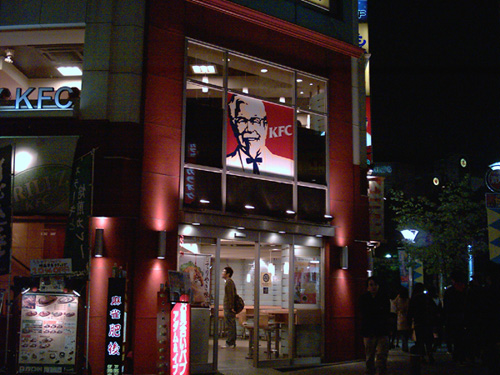
  • As most Japanese kitchens do not have ovens, Japanese people do not have turkeys at Christmas. The largest oven that people would have would be an oven toaster. Instead, they have a chicken dinner from KFC
KFC store in Ikebukuro
By kici (-) [Public domain], via Wikimedia Commons

  • This is because, in the 1970's, a customer in KFC's Aoyama store supposedly mentioned how there was no turkey available in Japan so fried chicken was the next closest thing at Christmas. 
  • Which led to an advertising campaign called 'Kentucky for Christmas. This was a huge success in Japan which also started the tradition of having Kentucky Fried Chicken for Christmas
  • Every Christmas, there are huge queues outside shops and some people also reserve food so they do not miss out.
  • Also Japanese people have Christmas cake as well.
  • It is usually a sponge cake covered in cream and strawberries. Occasionally it can be a Yule log.
  • The Christmas cake is a symbol of commercialism and prosperity. 
  • In World War 2, American soldiers helped to rebuild Japan. The economy was is a desolate state and food shortages were common.
  • To help the people, sweets were handed out by the American soldiers. Sweets were considered a  luxury to the people
  • Japan then embraced an American Christmas.
  • Sponge cakes could have been made since the 17th century but the sugar, butter and milk were considered a luxury
  • After the war, the economy improved and these ingredients became widely available for people to make sponge cakes
  • The colours are symbolic, red and white reflect the colours of the Japanese flag.
  • This is a picture of the yule log that I made for Christmas this year.

Fun fact: There is even a Christmas sponge cake emoji!
Christmas sponge cake emoji

The next big event for Japanese people in New years eve and day. I will be uploading posts about them soon! メリークリスマス!


Friday, 30 October 2015

Halloween!!!

After the Japan finished in the Rugby World Cup with a win against USA, I ran out of things to write about. Since it's nearly Halloween and I had no idea what to write about, I looked on the internet to see if and how Japan enjoyed Halloween. Here we go!

Halloween is not a national holiday but many people do celebrate it. When you hear the word 'Halloween', what is the first thing that comes into mind? Trick or treating? Sweets? Dressing up as scary things like ghosts and skeletons? For Japan, it's the dressing up. Otherwise known as cosplay (コスプレ)

Cosplay

Cosplay is an abbreviated term for costume play where people dress up and act like a fictional character. The term came from Japan but the concept of costume play actually started in the USA. Just because the term came from Japan, it does not necasserily mean that it is a Japanese or Asian hobby.
Some cosplayers in the USA
By The Conmunity - Pop Culture Geek from Los Angeles, CA, USA (Professor McGonagall, Harry Potter, Severus Snape) [CC BY 2.0 (http://creativecommons.org/licenses/by/2.0)], via Wikimedia Commons


Many young people find cosplaying enjoyable and some even start planning and making their costume months in advance

This year, there will be a MAG festa (a manga, anime and game festival) in Nakano, Tokyo on Halloween. It was first held last year and it attracted 50000 participants so this year, it is predicted that many cosplayers will come this year too! They can prepare in the changing rooms provided and join the parade and cosplay related events

The REAL Super Mario Cart
By MIKI Yoshihito (MARIO CART.) [CC BY 2.0 (http://creativecommons.org/licenses/by/2.0)], via Wikimedia Commons

Sweets
As Halloween gets more popular, there are more Halloween themed sweets around. For example, Krispy Kreme Japan has 4 different monster themed doughnuts. Also Kit Kat has released pumpkin flavoured kit kats which is very exciting. The snack that I really want to try is the pumpkin pudding flavoured Caramel corn. Caramel corns have a similar consistency to cheese puffs or Wotsits and they are extremely delicious and slightly addictive. Yum! \(^o^)/
Mister Doughnut doughnuts
By Karl Baron (Mister Donut halloween donuts) [CC BY 2.0 (http://creativecommons.org/licenses/by/2.0)], via Wikimedia Commons


Kawasaki Halloween parade

The most famous Halloween parade is in Kawasaki, Kanagawa prefecture. Parade participants walk along the 1.5km course near the JR Kawasaki station and the La Citadella shopping center and show off their hand made costumes. I hope you enjoy Halloween. Please write in the comments about how your country celebrates Halloween.


Kawasaki Parade
By Danny Choo from Tokyo, Japan (Kawasaki Halloween) [CC BY-SA 2.0 v(http://creativecommons.org/licenses/by-sa/2.0)], via Wikimedia Commons

Thursday, 1 October 2015

Sports day

In October, Japanese schools have Sports day! This was to commemorate the first Olympic Games in 1964, Tokyo which was held on October from the 10th to the 24th.

Usually, the Olympics are held in the summer but that year, the weather conditions were not suitable for atheletes from hot and cold countries. The summer months are too hot and humid to compete, spring was unstable weather wise and early autumn is the height of the typhoon and rainy season. Mid autumn was the best time because, the typhoon season is over and there is more sunshine. Thanks to this, the Opening Ceremony was staged underneath a cloudless sky.

Fun fact: Tokyo has hosted the Olympic Games two times and will next host it in 2020!

The teams

Here in England, you may be in a house with a team colour and name. In Japan however, there are only two houses, the Red house and the White house. Very creatively named. The colours of those houses should be fairly obvious. 

The events

The events vary from school to school but here is a list of some events
  • Team dancing
  • Track events
  • Relays
  • Throwing small balls into a tall basket
  • Pushing a large ball
  • Tug of war
If you are Japanese, please write in the comments what events you did when you were at school
もしあなたは日本人だったら、学校の運動会でどのイベントをやったかをコメントに書いてください。


Saturday, 26 September 2015

Wagashi (traditional Japanese sweets)

One thing that is very beautiful, delicious and Japanese is wagashi. Now, you're probably wondering what on earth wagashi is. Well, as written in the title, wagashi is a traditional Japanese sweet. It is often eaten with a cup of green tea and often reflects the season that it was made it. So, for example, wagashi made in autumn may have autumnal colours or shaped like a leaf.

Making wagashi is considered an art. Wagashi evokes the seasons and landscapes of Japan and appeal to all of the senses. The appearance will appeal to sight, the scent to smell, handling of the sweet to touch, the musical name which sometimes is associated with the seasons and of course, the taste of it.

There are many types of wagashi. Here is a list of some of my favorites;

  • Anmitsu (Chilled jelly-like cubes with fruit and sometimes a sweet syrup)
Anmitsu with azuki paste, black syrup and green tea
  • Amanatto (Sugar coated beans)
  • Dango (Mochi balls skewered on a stick)
Coloured dango
By gochie* (花より・・・) [CC BY 2.0 (http://creativecommons.org/licenses/by/2.0)], via Wikimedia Commons

  • Dorayaki (Two small pancakes containing azuki bean paste)
  • Dorayaki
    By Ocdp (Own work) [CC BY-SA 3.0 (http://creativecommons.org/licenses/by-sa/3.0)], via Wikimedia Commons
  • Kuri kinton (Sweet chestnut paste)
  • Taiyaki (A fried waffle containing azuki bean paste)
Taiyaki
By ProjectManhattan (Own work) [CC BY-SA 3.0 (http://creativecommons.org/licenses/by-sa/3.0)], via Wikimedia Commons
  • Yokan (A solid block of azuki bean paste, solidified with agar and sugar)

Recently I have been trying some different wagashi. One of them is called 甘納豆 (amanatto) or sugar coated azuki beans.

It came in this really pretty box

The contents

Daifuku bean

Azuki beans with a cup of green tea

Uguisu beans

Opinion: They were sweet but not too sweet and were absolutely delicious with some green tea. Unfortunately, you cannot buy amanatto in the UK so if you are in Japan, definitely try and find some because they are delicious.

Also, I tried some yokan too.

Here is the box

Once you remove the paper packaging, this is what it looks like

Once you open the box, this is what the yokan packaging looks like

I only tried the honey flavored yokan

And this is what yokan looks like
Opinion: I found it very tasty, it was sweet but not unbearably sweet. I would compare it to a really hard jelly baby. Green tea really goes well with it.

So if you are around in Japan, go and try some wagashi. I recommend the Toraya shop in Ginza and the number of shops in Asakusa.

Sunday, 20 September 2015

Autumn in Japan

So, it's that time of year again. People go back to school, work and trees put on a spectacular show before it's winter. Japan is no exception. So I thought that I could start writing an overview about autumn in Japan

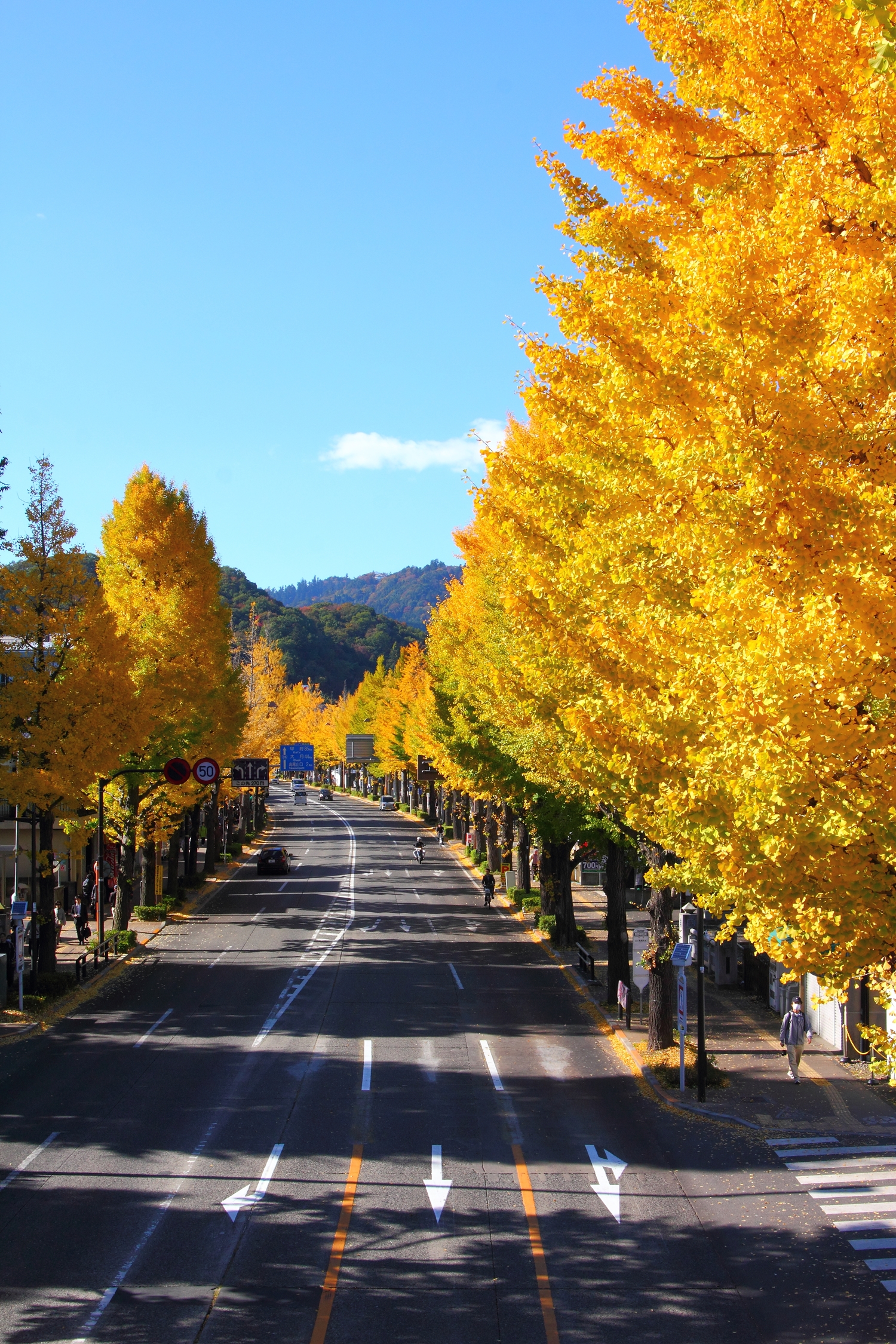
Because of Japan's north-south extension, you can see the leaves changing colour and falling over three months. Hokkaido is the first to feel the effect of the autumn. The leaves here start changing from mid September to late October. The warmest areas of Japan like, Okinawa feel the effect of autumn last as it is one of the warmest places in Japan.
Hachioji (Tokyo)
By Kakidai (Own work) [CC BY-SA 4.0 (http://creativecommons.org/licenses/by-sa/4.0)], via Wikimedia Commons

After the long, hot humid summer, autumn is a welcome sign that the temperature will cool down considerably. Temperatures become more comfortable, which is probably one reason that the most popular season in Japan is autumn. A really good place to see the leaves change colour in Tokyo is Meiji-jingu temple in Shinjuku. I will put details on how to find it at the bottom.

Nature, being an integral part of the Japanese culture can be enjoyed everywhere. You can go to places of historical importance to walk through while taking in the colours of the ginko and maple trees.

Food is also an important part of the Japanese autumn. Matsutake mushrooms are being used very often in cooking as they are in season. Most foods are in season so there is a variety of food that you can eat. Delicious fruit such as Japanese pears, persimmons and chestnuts are also in season. You can find them in asian supermarkets and occasionally normal supermarkets. If you find some, I highly recommend that you try it. You will definitely find them in Japanese supermarkets. I might put a few autumn recipies in my next posts.

So if you are around in Japan in the autumn, enjoy the most popular season! Leave a comment about your experiences of a Japanese autumn!

Where to find places;
Meiji jingu temple: Just behind the JR Harajuku station.


Sunday, 23 August 2015

Japan festival ♪───O(≧∇≦)O────♪

Hi guys! I thought that I would tell you about the Japan Matsuri. If you go to Trafalgar Square in London, on the 19th September, you can eat Japanese food, see taiko players and take part in many Japanese activities. Here is a poster about the details:
I hope that you are able to go and get a snapshot of Japanese culture.

Thursday, 20 August 2015

Emoji

This is not a 'Summer in Japan' post as you might have noticed. I am currently writing this after I realised that the violin emoji looked like a cello.
Is this emoji a violin or a cello?
Please leave your comments down below?

I did some research on the internet and it says that it is a violin. Where is the chin rest? The bow is too short.

Anyway, emojis also happen to be from Japan so here is my lists of fun facts about emojis?

About the word emoji

The word emoji comes from the Japanese word for picture, 絵 (e), and the word for word, 文字 (moji). So it literally means picture word.

The sun picture is used for
making weather forecasts clear.

Why were emojis invented?

  • In 1999, the letter count for texting was very small, only 48 letters. Shigetaka Kurita (the creator of emojis) tried to come up with a way to send concise messages without going over the letter count. 
  • He thought that as we are so used to seeing pictures to convey a message like this sun, for sunny weather, we could use it for sending messages to each other.
  • They were popular because one emoji could go a long way.
  • They were also popular because, you could express ideas better through pictures than through words.


The difference between emojis and emoticons

Let me make one thing clear. Emojis and emoticons are not the same thing!

Definition of an emoji: A small digital image or icon used to express an idea or emotion in electronic communication

Definition of an emoticon: A representation of a facial expression such as a smile or frown, formed by various combinations of keyboard characters and used in electroniccommunications to convey writer's feelings or intended tone.

So the purpose is different


←Emojis look like this
             Emoticons look like this→


National emoji day!
So they look completely different as well.


National emoji day 

  • There is a national emoji day, it is on July 17. 
  • This is because the calendar emoji has July 17 on it!
  • You are probably wondering why it is July 17 and not any other date. It is because, the app iCal was premiered at the MacWorld conference in 2002 on that date.
  • Here is a link to see how you can celebrate national emoji day! 

Which emoji is the most popular?

I found a website that shows you the live usage of each emoji on twitter. Here is the link to that website. At the time of writing, top ten most popular emojis were:

Which country uses a certain emoji the most?

Researchers from Swiftkey looked at 1 billion pieces of data across 16 different languages for trends in the use of emojis. This is what they found:
The heart emoji is most used by France
The poo emoji is most used by Canada
50% of emojis sent in Britain are smiley
emojis
The winking emoji is the most popular
emoji in Britain


One of the emojis used most by Americans is
the pizza emoji
Arabic users use the rose emoji tens times
more than everyone


If there are any more emoji statistics that you would like me to include, please tell me in the comments. I hope that you enjoy reading this as much I had fun writing this post.

Thursday, 13 August 2015

Summer in Japan- Obon

This post is about one of the most important Buddhist festivals in Japan. Obon (or Bon) is the time of year when your ancestors spirits come to this world in order to visit relatives. Obon is not an official public holiday but most people can absent from work at this time. Most people usually go home to their parents' house to celebrate Obon.


Who celebrates when?

Obon is celebrated for three days between 1st July and 15 August. Why is it organized on different dates? Well, in the Meiji era, the Gregorian calendar replaced the Lunar calendar but not all regions in Japan accepted it at the same time. My grandfather and father celebrate in July.

  • Shichigatsu Bon is celebrated around the 15th July. People who live in the Tokyo, Yokohama and Tohoku region celebrate then.
  • Kyu Bon is celebrated on the 15th of the seventh lunar month. People who live in the north of the Kanto region, Chugoku, Shikoku and the south western islands celebrate according to the moon.
  • Hachigatsu Bon is celebrated around the 15th August. The rest of Japan celebrate then.

What happens during Obon


NB: There are many variations on how Obon is celebrated. This is a rough overview of the festival
  • Japanese people get together with their family and spend time together.
  • The house and their graves must be tidy for the spirits.
  • Before the spirits arrive, most Japanese families set up an decorative altar.  My father and grandfather decorated my grandmother's altar with fllowers, fruit and lanterns.
  • How Japanese families celebrate Obon depends on the region that they live in. Some Japanese families help their ancestors arrive by making vehicles for them. As they do not have cars to get here, they make a horse for them. The horse symbolises how they can arrive at the house as quickly as possible. It is made out of a cucumber and some chopsticks.  A cow or bull is also made which symbolises how the spirit can ride home at a leisurely pace. This is made out of an aubergine and chopsticks. Both animals are placed on a shelf on the altar. Recently, some families have gone to great lengths to make vehicles.  Click here to see some creative しょうりょうま (shouryouma) 
Shouryouma
I, Katorisi [GFDL (http://www.gnu.org/copyleft/fdl.html) or CC BY 3.0 (http://creativecommons.org/licenses/by/3.0)], via Wikimedia Commons

  • On the 13th of August, light the chochin lantern
  • In the evening,  go to their grave and welcome the spirits home. Lighting a pile of hemp or straw in front of the house helps the spirits find their way to your house. This is called 迎火 (mukaebi). If you light some inscense, the spirits can travel on the smoke on the horse to arrive at the house.
MukaebiI, Katorisi [GFDL (http://www.gnu.org/copyleft/fdl.html) or CC BY 3.0 (http://creativecommons.org/licenses/by/3.0)], via Wikimedia Commons

  • Once they enter your house, offer them food and drink.
  • On the last day of Obon, there will be a dance called the Bon Odori dance. The purpose of this dance is to welcome and send back all relatives as well as some angry spirits that have found their way here. Each region has its own Obon dance and music.
Bon OdoriBy Yasu (Own work) [CC BY-SA 3.0 (http://creativecommons.org/licenses/by-sa/3.0) or GFDL (http://www.gnu.org/copyleft/fdl.html)], via Wikimedia Commons

  • For their final send off, you use fire just like you did to welcome them here. some regions float lanterns down a river to guide them back to their world.
Tourou nagashi
By 藤谷良秀 (Own work) [CC BY-SA 3.0 (http://creativecommons.org/licenses/by-sa/3.0)], via Wikimedia Commons

This festival is very similar to the Mexican festival, Dia de los Muertos. They remember and celebrate the dead on the 31 October.

This is probably going to be my last post on Japanese summers. I may continue this series if you would like me to. Please comment if you liked this post or if you want me to continue this series next year. Please subscribe and come back to this blog again. \(^o^)/

Summer in Japan- Survival guide

This is my survival guide to staying in Japan in the summer.
  1. Escape the heat
Just going to a department store or any building can really help keep you cool. You can also do some shopping while you are there. It can also help you save money on your energy bills too.

     2. Bring a ton of suncream and a hat

As the sun is very strong in the summer, it is very important to put on plenty of suncream so you do not burn or get sunstroke. Hats keep harmful UV rays away from your face, head and neck.

    3. Keep hydrated

On every street, station and building, there is usually a vending machine or a convinience store where you can buy cold beverages. I reccommend unsweetened iced tea because it is tasty and refreshing. I also reccomend a range of juices called 野菜生活 (yasai seikatsu). Yasai seikatsu is a brand of juice that contain a large amount of vegetables and some fruit. They all taste great but my favourite is the 'Fruity salad' juice.

Japanese vending machine with
hot and cold drinks

kyu3 [CC BY-SA 2.1 jp
kyu3 [CC BY-SA 2.1
jp (http://creativecommons.org/
licenses/by-sa/2.1/jp/deed.en)],
via Wikimedia Commons
Yasai seikatsu Fruity salad juice


4. Have a fan on you

A way that people in Japan advertise is by handing out packs of tissues with adverts and offers on. In summer, some companies advertise with practical objects like plastic uchiwa fans. If see anyone giving out fans, take it!

    5. Eat cold food

During the summer months, eating cold food helps you keep you cool. Somen noodles are Japanese noodles that are very very thin and are made from wheat flour.  It is similar to Angel hair pasta. They are usually eaten cold and dipped in a special dipping sauce made out of soy sauce and dashi. Eating hiyayakko in the summer can also keep you cool. It is chilled tofu and is usually eaten with a little sprinkling of bonito flakes and some soy sauce. Watermelon is a great fruit to eat in the summer. However eating too much cold things can actually stop your body from cooling down. So to stop this from happening, have some warm or hot food once in a while.


Somen noodles with spring onion and dipping sauce
By shibainu (Flickr) [CC BY 2.0
(http://creativecommons.org/licenses/by/2.0)],
 via Wikimedia Commons
Hiyayakko
By Namiwoo (Own work)
[CC BY-SA 3.0 (http://creativecommons.org/licenses/by-sa/3.0)],
 via Wikimedia Commons


 Somen noodles
6. Wear breathable clothes


It gets very muggy so wearing breathable clothes helps you feel more comfortable in the heat. But it is a good idea not to wear skimpy clothes. Sandals are also good to wear outside.


   7. Use an ice pillow

Japanese people do not really use ice pillows unless they have a fever, as they have air conditioning. If you have access to a freezer, there are special pillows that you can put in the freezer to cool. Before you use them, wrap a thin towel around the pillow so you protect the skin that is exposed to the ice pillow.


My ice pillow

If you enjoyed this post, please share it to other people who might enjoy reading this. I have also added a followers gadget, so please become a follower if you want to know when I next upload a post. さよなら。