Showing posts with label festival. Show all posts

Wednesday, 3 February 2016

Setsubun festival

On the 3rd of February, every year, there is a festival called Setsubun (節分).

On the evening of the festival,  Japanese families do mamemaki (豆まき). This is when, a wooden container is filled with roasted soy beans and then they throw the beans around the room whilst shouting 'Oni wa soto, fuku wa uchi' (鬼は外、福は内) which roughly translates as 'Goblins out, good fortune in!' This is to drive out bad fortune and evil and keep good fortune and happiness in.
Afterwards, you eat the same number of beans as your age. So for example if you are 7, you eat 7 beans. But this may not always be possible because if you are, for example 89, there may not be enough to have 89 beans. Eating too many soy beans is not be too good for you as they contain a substance that is not good for us in large quantities, so watch the amount that you eat! Also, there have recently been articles in the news that the beans are a possible choking hazard for children under the age of 3. Here is the article. So sadly, not everyone can take part in the festivities.

The roasted soy beans and the goblin masks
By katorisi (Own work) [GFDL (http://www.gnu.org/copyleft/fdl.html) or CC BY-SA 3.0 (http://creativecommons.org/licenses/by-sa/3.0)], via Wikimedia Commons

This is usually a fun event for families especially if there are young children as someone dresses up or wears a goblin mask while the others throw roasted soy beans at the goblin.

I hope all of the setsubun celebrations go well and everyone has good fortune for the rest of the year!

If you would like me to write about a certain topic, please leave it in the comments!


Friday, 25 December 2015

Christmas in Japan-Food

The food is one of the things that people look forward to at Christmas. And Japan is no exception.

Food

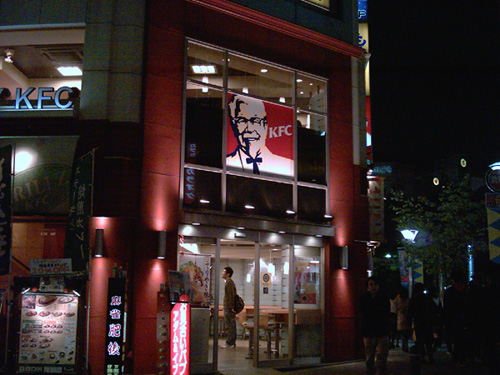
  • As most Japanese kitchens do not have ovens, Japanese people do not have turkeys at Christmas. The largest oven that people would have would be an oven toaster. Instead, they have a chicken dinner from KFC
KFC store in Ikebukuro
By kici (-) [Public domain], via Wikimedia Commons

  • This is because, in the 1970's, a customer in KFC's Aoyama store supposedly mentioned how there was no turkey available in Japan so fried chicken was the next closest thing at Christmas. 
  • Which led to an advertising campaign called 'Kentucky for Christmas. This was a huge success in Japan which also started the tradition of having Kentucky Fried Chicken for Christmas
  • Every Christmas, there are huge queues outside shops and some people also reserve food so they do not miss out.
  • Also Japanese people have Christmas cake as well.
  • It is usually a sponge cake covered in cream and strawberries. Occasionally it can be a Yule log.
  • The Christmas cake is a symbol of commercialism and prosperity. 
  • In World War 2, American soldiers helped to rebuild Japan. The economy was is a desolate state and food shortages were common.
  • To help the people, sweets were handed out by the American soldiers. Sweets were considered a  luxury to the people
  • Japan then embraced an American Christmas.
  • Sponge cakes could have been made since the 17th century but the sugar, butter and milk were considered a luxury
  • After the war, the economy improved and these ingredients became widely available for people to make sponge cakes
  • The colours are symbolic, red and white reflect the colours of the Japanese flag.
  • This is a picture of the yule log that I made for Christmas this year.

Fun fact: There is even a Christmas sponge cake emoji!
Christmas sponge cake emoji

The next big event for Japanese people in New years eve and day. I will be uploading posts about them soon! メリークリスマス!


Friday, 30 October 2015

Halloween!!!

After the Japan finished in the Rugby World Cup with a win against USA, I ran out of things to write about. Since it's nearly Halloween and I had no idea what to write about, I looked on the internet to see if and how Japan enjoyed Halloween. Here we go!

Halloween is not a national holiday but many people do celebrate it. When you hear the word 'Halloween', what is the first thing that comes into mind? Trick or treating? Sweets? Dressing up as scary things like ghosts and skeletons? For Japan, it's the dressing up. Otherwise known as cosplay (コスプレ)

Cosplay

Cosplay is an abbreviated term for costume play where people dress up and act like a fictional character. The term came from Japan but the concept of costume play actually started in the USA. Just because the term came from Japan, it does not necasserily mean that it is a Japanese or Asian hobby.
Some cosplayers in the USA
By The Conmunity - Pop Culture Geek from Los Angeles, CA, USA (Professor McGonagall, Harry Potter, Severus Snape) [CC BY 2.0 (http://creativecommons.org/licenses/by/2.0)], via Wikimedia Commons


Many young people find cosplaying enjoyable and some even start planning and making their costume months in advance

This year, there will be a MAG festa (a manga, anime and game festival) in Nakano, Tokyo on Halloween. It was first held last year and it attracted 50000 participants so this year, it is predicted that many cosplayers will come this year too! They can prepare in the changing rooms provided and join the parade and cosplay related events

The REAL Super Mario Cart
By MIKI Yoshihito (MARIO CART.) [CC BY 2.0 (http://creativecommons.org/licenses/by/2.0)], via Wikimedia Commons

Sweets
As Halloween gets more popular, there are more Halloween themed sweets around. For example, Krispy Kreme Japan has 4 different monster themed doughnuts. Also Kit Kat has released pumpkin flavoured kit kats which is very exciting. The snack that I really want to try is the pumpkin pudding flavoured Caramel corn. Caramel corns have a similar consistency to cheese puffs or Wotsits and they are extremely delicious and slightly addictive. Yum! \(^o^)/
Mister Doughnut doughnuts
By Karl Baron (Mister Donut halloween donuts) [CC BY 2.0 (http://creativecommons.org/licenses/by/2.0)], via Wikimedia Commons


Kawasaki Halloween parade

The most famous Halloween parade is in Kawasaki, Kanagawa prefecture. Parade participants walk along the 1.5km course near the JR Kawasaki station and the La Citadella shopping center and show off their hand made costumes. I hope you enjoy Halloween. Please write in the comments about how your country celebrates Halloween.


Kawasaki Parade
By Danny Choo from Tokyo, Japan (Kawasaki Halloween) [CC BY-SA 2.0 v(http://creativecommons.org/licenses/by-sa/2.0)], via Wikimedia Commons

Sunday, 23 August 2015

Japan festival ♪───O(≧∇≦)O────♪

Hi guys! I thought that I would tell you about the Japan Matsuri. If you go to Trafalgar Square in London, on the 19th September, you can eat Japanese food, see taiko players and take part in many Japanese activities. Here is a poster about the details:
I hope that you are able to go and get a snapshot of Japanese culture.

Thursday, 13 August 2015

Summer in Japan- Obon

This post is about one of the most important Buddhist festivals in Japan. Obon (or Bon) is the time of year when your ancestors spirits come to this world in order to visit relatives. Obon is not an official public holiday but most people can absent from work at this time. Most people usually go home to their parents' house to celebrate Obon.


Who celebrates when?

Obon is celebrated for three days between 1st July and 15 August. Why is it organized on different dates? Well, in the Meiji era, the Gregorian calendar replaced the Lunar calendar but not all regions in Japan accepted it at the same time. My grandfather and father celebrate in July.

  • Shichigatsu Bon is celebrated around the 15th July. People who live in the Tokyo, Yokohama and Tohoku region celebrate then.
  • Kyu Bon is celebrated on the 15th of the seventh lunar month. People who live in the north of the Kanto region, Chugoku, Shikoku and the south western islands celebrate according to the moon.
  • Hachigatsu Bon is celebrated around the 15th August. The rest of Japan celebrate then.

What happens during Obon


NB: There are many variations on how Obon is celebrated. This is a rough overview of the festival
  • Japanese people get together with their family and spend time together.
  • The house and their graves must be tidy for the spirits.
  • Before the spirits arrive, most Japanese families set up an decorative altar.  My father and grandfather decorated my grandmother's altar with fllowers, fruit and lanterns.
  • How Japanese families celebrate Obon depends on the region that they live in. Some Japanese families help their ancestors arrive by making vehicles for them. As they do not have cars to get here, they make a horse for them. The horse symbolises how they can arrive at the house as quickly as possible. It is made out of a cucumber and some chopsticks.  A cow or bull is also made which symbolises how the spirit can ride home at a leisurely pace. This is made out of an aubergine and chopsticks. Both animals are placed on a shelf on the altar. Recently, some families have gone to great lengths to make vehicles.  Click here to see some creative しょうりょうま (shouryouma) 
Shouryouma
I, Katorisi [GFDL (http://www.gnu.org/copyleft/fdl.html) or CC BY 3.0 (http://creativecommons.org/licenses/by/3.0)], via Wikimedia Commons

  • On the 13th of August, light the chochin lantern
  • In the evening,  go to their grave and welcome the spirits home. Lighting a pile of hemp or straw in front of the house helps the spirits find their way to your house. This is called 迎火 (mukaebi). If you light some inscense, the spirits can travel on the smoke on the horse to arrive at the house.
MukaebiI, Katorisi [GFDL (http://www.gnu.org/copyleft/fdl.html) or CC BY 3.0 (http://creativecommons.org/licenses/by/3.0)], via Wikimedia Commons

  • Once they enter your house, offer them food and drink.
  • On the last day of Obon, there will be a dance called the Bon Odori dance. The purpose of this dance is to welcome and send back all relatives as well as some angry spirits that have found their way here. Each region has its own Obon dance and music.
Bon OdoriBy Yasu (Own work) [CC BY-SA 3.0 (http://creativecommons.org/licenses/by-sa/3.0) or GFDL (http://www.gnu.org/copyleft/fdl.html)], via Wikimedia Commons

  • For their final send off, you use fire just like you did to welcome them here. some regions float lanterns down a river to guide them back to their world.
Tourou nagashi
By 藤谷良秀 (Own work) [CC BY-SA 3.0 (http://creativecommons.org/licenses/by-sa/3.0)], via Wikimedia Commons

This festival is very similar to the Mexican festival, Dia de los Muertos. They remember and celebrate the dead on the 31 October.

This is probably going to be my last post on Japanese summers. I may continue this series if you would like me to. Please comment if you liked this post or if you want me to continue this series next year. Please subscribe and come back to this blog again. \(^o^)/

Tuesday, 4 August 2015

Summer in Japan-Fireworks

One of the most important parts of summer in Japan are the fireworks! Fireworks in japanese is 花火 (hanabi).

Fun fact: If you translate the japanese word for firework literally, it means fire flower.

During the summer, there will be a firework display on the weekend somewhere in Japan. As there are many firework displays in Japan, I thought that I would write about the most famous one in Tokyo

Sumida River fireworks festival-Tokyo

Sumida River fireworks festival next to the Tokyo Skytree
By てんどん (http://photozou.jp/photo/show/141110/145311514) [CC BY 2.1 jp (http://creativecommons.org/licenses/by/2.1/jp/deed.en)], via Wikimedia Commons
This is a firework festival that takes place every year on the last Saturday of July over the Sumida river near Asakusa. Nearly a million people come to watch this display. As there are so many spectators, the fireworks are set off from two locations so everyone can see. In this display, two rival pyrotechnic groups compete against each other and make better fireworks than their opponent. The Tamaya and the Kagiya makes fireworks of different shapes, colours and patterns to make an inpressive display for everyone watching. Two sightseeing spots are the Sensoji temple and the Tokyo Skytree. 

The Tokyo Skytree 

Sensoji temple
By Leonard V Carlson / Picturetokyo at English Wikipedia
 [Public domain], via Wikimedia Commons
Fun fact 2: Fireworks were originally used to scare off demons.

History

It started in 1732 as part of the festival for the dead when there was poverty, famine and disease. The fireworks were used to entertain the masses. At this time the festival was called 両国川開(Ryogoku Kawabiraki). This tradition continued until World War 2 started. Even when World War 2 was over, the festival did not recommence after 1978. This tradition still carries on to this day

if you enjoyed this post, please comment. If you want to know about another aspect of Japan, please leave it in the comments.


Tuesday, 7 July 2015

Tanabata

Tanabata celebration in Asagaya
By ITA-ATU
(contributor photographed)
[Public domain], via Wikimedia Commons
Tanabata is a festival on the 7th of July which celebrates the meeting of the two stars, Vega and Altair. The two stars are also known as the deities 織姫 (Orihime) and 彦星 (Hikoboshi). Japanese legend says that the Milky Way separated the lovers and could only once a year.

Japanese people hang coloured, narrow strips of paper onto bamboo branches and write their wishes and Orihime makes it come true. What is really meant to happen is that you write down your resolution down. They also decorate the bamboo with paper decorations like paper chains and stars. For some people, this festival marks how the summer holiday is near

Japanese people dress in ゆかた(yukata) is a casual summer kimono often worn at summer. At  festivals, there is a variety of foodstalls which sell food like 焼きそば(yakisoba) and 焼き鳥(yakitori). Yakisoba are chow mein noodles which have been stir fried with a sauce, meat, cabbages and other vegetables. There is always pickled ginger on top. Yakitori are pieces of chicken which have been barbecued with a slightly sweet soy based sauce. Sometimes, they are served which just a sprinkling of
salt.

Sendai (Miyagi prefecture) and Hiratsuka (Kanagawa prefecture) are famous for their Tanabata displays.

Yakisoba
By yoppy (Flickr) [CC BY 2.0
(http://creativecommons.org/licenses/by/2.0)],
via Wikimedia Commons

Male and Female yukata
By Corpse Reviver (Own work) [CC BY-SA 3.0
(http://creativecommons.org/licenses/by-sa/3.0)],
via Wikimedia Commons
Yakitori
By 竹麦魚(Searobin) (Own work)
 [GFDL (http://www.gnu.org/
copyleft/fdl.html),
CC-BY-SA-3.0 (http://creativecommons.
org/licenses/by-sa/3.0/)
 or CC BY-SA 2.1 jp
(http://creativecommons.org/licenses
/by-sa/2.1/jp/deed.en)],
via Wikimedia Commons

The story behind the festival


Orihime was the daughter of  天帝 (Tentei) who was the universe himself wove beautiful clothes by the bank of the 天の川 (Milky way). Tentei was the Emperor. She worked very hard to weave the clothes. She was sad because she was lonely amd could never fall in love with anyone. Her father arranged for her to meet Hikoboshi who was a cow herder on the other side of the Milky way. When they met, they fell in love instantly and married. Orihime no longer weaved and Hikoboshi let his cows wonder to heaven.
Tentei got angry and forbade them from meeting. Orihime wanted to meet Hikoboshi so much so she
cried. Her father felt sorry for his daughter and allowed her to meet him on the 7th July as long as she carried on weaving. On the day that they were meant to come together, the river (Milky way) was too hard to cross so she got upset. A flock of magpies came and made a bridge for her to cross. The magpies would only come when it is not raining on Tanabata, so people always wish for good weather. This is just one variation of the legend.

Fun fact: In Japanese stations, there will be a short melody that is played when trains are about to depart. In Hiratsuka station, the name of the melody is called 七夕様 (Tanabatasama) which means Orihime.
Hiratsuka station
By そらみみ (Own work) [CC BY-SA 3.0 (http://creativecommons.org/licenses/by-sa/3.0)], via Wikimedia Commons

Fun fact 2: The original packaging design of a popular Japanese soft drink called カルピス (calpico) was based on the Milky Way.

If you liked this post, please leave a comment. If you want me to write about something in particular, please leave that in the comments too.