Monday, 15 August 2016

Tokyo Olympics 2020

As you all know, the 2016 Olympics in Rio are already underway so I thought that this would be a good time to write about the Tokyo Olympics in 2020.

How many times has Tokyo bid for the Olympic games?

Tokyo has bid for the Games 5 times in total. 

  1. Tokyo first bid for the 1940 Summer Olympics and won but unfortunately could not host the Games due to WWII. 
  2. Then they bid for the 1960 Games but they lost to Rome. 
  3. 1964 however, was a successful bid and became the first Asian country to host the Olympic Games. 
  4. As Tokyo wished to host again, they bid for the 2016 Games but they lost to Rio. 
  5. And finally, four years later, they won the bid for the 2020 Olympic Games.
But Tokyo is not the only city that has bid for the Olympics. 
  • Osaka tried to host the 2008 Olympics but lost to Beijing
  • Nagoya tried to host the 1988 Olympics and lost to Seoul
  • Sapporo was given the 1940 Winter Olympics but as WWII broke out, they never hosted it
  • Sapporo tried again in 1968 but Grenoble won
  • Third time lucky, Sapporo got to host the 1972 Winter Olympics and became the first Asian country to do so.
  • Soon afterwards, Sapporo tried for the 1984 and lost to Sarajevo
  • In 1998, Nagano won the bid to host the Winter Olympics.
That's a lot of bids.

On September 7, Tokyo won the bid to host the 2020 Olympic Games. Hooray!

Construction work

For the Olympic stadium, they are demolishing the old stadium that was used for the 1964 and build the 新国立競技所 (New National Stadium). Demolition finished in October 2015 and the construction of the new stadium will start this in 2017, to be ready for the Olympics.

Most venues for the sports have been used in previous Olympics, 11 new venues will be built

The Heritage zone is an area where old venues that were used in the 1964 Games will be used again. The Tokyo Bay zone however is a place for future modern development.
5 venues will be in neither zone, most of the venues are the ones that need more space like golf and the football matches.

The events

As well as the usual events, baseball and softball will make a comeback and 4 new events will take place: surfing, karate, skateboarding and sport climbing.

The Olympic logo

As you may have heard, the original Olympic logo had to be changed as it looked too similar to the logo for the Theatre de Liege. So the new logo created by Asao Tokolo is meant to show "the refined elegance and sophistication that exemplifies Japan" according to the Tokyo Emblems Selection Committee. The three regular quadrilaterals are meant to symbolise the "different countries, cultures and the ways of thinking" and the idea of "unity in diversity" according to the organisers

The Olympic mascots

At the time of writing, the mascots for the 2020 Olympics have not been announced but will be updated when it is.

Gooooo Japan! Please leave in the comments what you are looking forward to in the current Olympics or in Olympics to come. 

Sunday, 10 July 2016

Green tea!

Recently, there has been a lot of interest in the media about the benefits of green tea that I was not aware of. However, I am aware of the different types of tea in Japan and so I decided to look into this important part of life in Japan.

So, tea is the most commonly drunk beverage in Japan. The japanese word for tea is (ocha) which usually means green tea. So here are some facts about green tea and other types of tea

Let's get this par-TEA started!
(This is the start of my terrible pun making)

  • Green tea is a fundamental part of Japanese culture, it is now widely available everywhere. Restaurants will serve a complimentary cup of tea while you get seated, you can buy it in any convenience store like 7 Eleven and in all beverage vending machines.
  • Depending on the position of the leaf on the plant, how the leaves were cultivated, steamed, dried and processed, the green tea can be classified as Ryokucha, Matcha, Houjicha, Konacha, Genmaicha, Oolongcha or Kocha
Lets go into more TEA-tail

Ryokucha

  • The timing of the harvest and the amount of sunlight the leaves are subjected to will choose which grade of green tea they are in
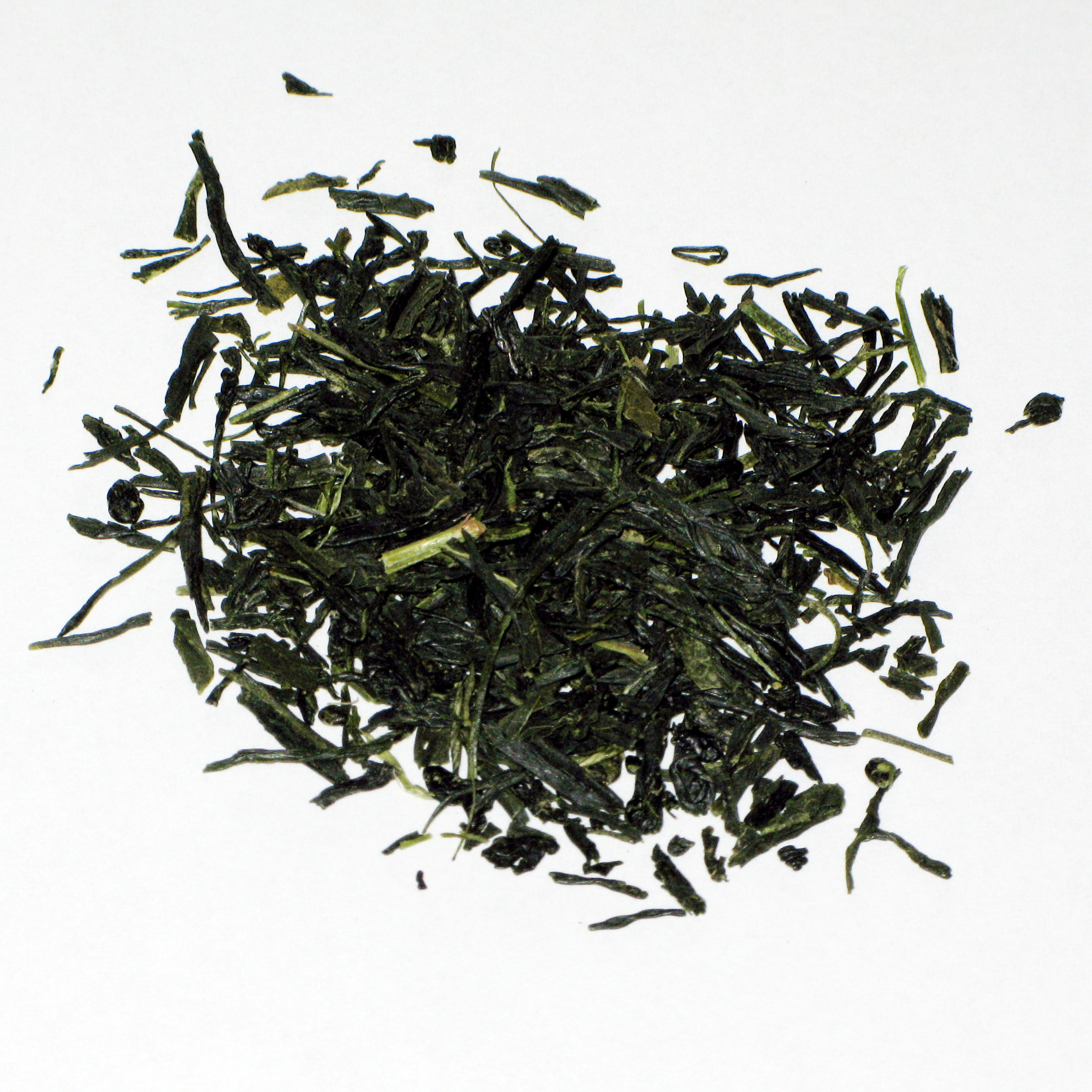
  • Gyokuro is the highest grade of green tea. Gyokuro is shaded from the sun before being picked in the first round of the harvest
Gyokuro leaves
By Rama (Own work) [CeCILL (http://www.cecill.info/licences/Licence_CeCILL_V2-en.html) or CC BY-SA 2.0 fr (http://creativecommons.org/licenses/by-sa/2.0/fr/deed.en)], via Wikimedia Commons

  • Sencha is treated the same way as gyokuro leaves but they are not shaded from the sun before harvesting
Sencha leaves
By Stefan Kühn (Own work) [CC BY-SA 3.0 (http://creativecommons.org/licenses/by-sa/3.0)], via Wikimedia Commons

  • Bancha is a lower grade of tea, these leaves are harvested in the later rounds of the harvest.
Bancha leaves
By Lutz 008 (Own work) [CC SA 1.0 (http://creativecommons.org/licenses/sa/1.0/)], via Wikimedia Commons

Matcha
  • This is a powdered green tea where only the highest quality leaves are used.
  • They are dried, milled finely and when you want to drink it, you simply add hot water.
  • Matcha is used in the tea ceremony
Matcha powder
By 121stephen (Matcha Tee) [CC BY-SA 3.0 (http://creativecommons.org/licenses/by-sa/3.0)], via Wikimedia Commons

Konacha
  • This is tea made of tea dust, tea buds and small tea leaves which have not been harvested
  • Even though this is considered a lower grade of tea, it will still complement foods such as sushi
Hojicha
  • This is a tea made out of roasted tea leaves.
  • The roasting of the leaves gives the leaves a reddish brown colour, the heat starts a chemical reaction which releases a pleasant sweet smell.
Hojicha
By myself (Own work) [Public domain], via Wikimedia Commons

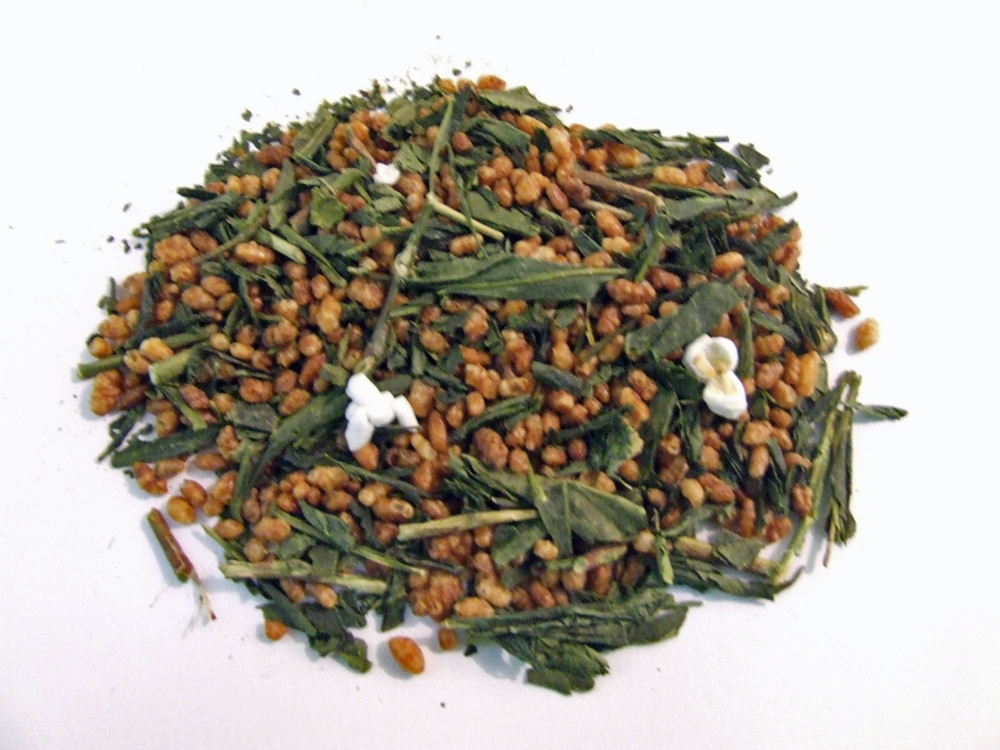
Genmaicha
  • This is a green tea which also has roasted brown rice
  • The genmai grains are roasted and mixed with tea leaves which add a yellowish colour and a distinctive flavour
  • It is a popular alternative to green tea
Genmaicha
By No machine-readable author provided. Kyd assumed (based on copyright claims). [Public domain], via Wikimedia Commons

Oolongcha
  • This is actually a Chinese tea but it is also a popular beverage in Japan as well.
  • The tea leaves here are left to oxidize and when they have oxidized enough, the leaves are steamed and roasted. This stops the oxidization of the leaves.
  • So I guess you could say that Chinese tea is so good as it takes OOLONG time to prepare!
Oolongcha
By Shizuha (Own work) [CC BY-SA 3.0 (http://creativecommons.org/licenses/by-sa/3.0)], via Wikimedia Commons

Kocha
  • Kocha is a tea similar to oolongcha but the leaves are left to oxidized even more so the leaves are even darker in colour compared to the oolongcha leaves.
  • The tea itself is red in colour and is available in many Western style cafes and restaurants.
Now for the teas that do not come from the tea plant.

Mugicha
  • This is a tea made from roasted barley.
  • This is a tea which is more popular with children as it does not contain caffeine.
  • I really like mugicha, the caffeine free tea brings out my inner tranquili-TEA!
Kombucha
  • This is a tea made from sliced or dried kombu seaweed.
  • It does not really taste of tea, it is more salty in taste.
  • I have never had this tea before, maybe I should give this a chai!

Health benefits of green tea

Green tea is said to contain:
  • Vitamin B
  • Folates
  • Manganese
  • Potassium
  • Antioxidants
But is it really a superfood (or superdrink in this case)?

According to the NHS website, green tea does not help prevent cancer. Although in 2015, there was an investigation into whether drinking green tea with a drug called Herceptin was effective in fighting breast and stomach cancer. The initial results were good so human trials will happen soon.

Green tea is said to help weight loss due to caffeine and the antioxidant called catechin . But in a 2012 review according to the NHS, there was no significant effect of weight loss from this hot beverage.

High cholersterol is thought to be lowered by drinking green tea. A review in 2013 found that daily consumption can lower cholesterol and blood pressure due to the catechins but the long term effects are unknown.

Green tea has been proven to lower blood pressure but whether it can prevent heart disease or strokes is not known

This fact about green tea is a fun one, a study in 2014 compared the use of green tea as a mouth wash to prevent tooth decay to the more commonly used antibacterial chlorhexidine. The results showed that they were both equally effective in preventing tooth decay

So, I guess that green tea is not really a superfood. But its still a really good drink.

Please put your tea based puns in the comments section, I'll have fun looking at all of the creativi-TEA!

Thursday, 23 June 2016

Tokyo Skytree

Next, I will write about the Tokyo Skytree
I actually talked about the Skytree for an English presentation
Here's the slide that I used
Top left; Location of Skytree
Top right; Height of the Skytree in comparison to other buildings
Bottom Left; The stages of building the Skytree
Bottom right; Skytree at day and night

  • The Skytree is the tallest tower in the world and it stands at 634m tall
  • It is in the Sumida ward
  • You may think that the Burj Khalifa in Dubai is the tallest in the world but it is considered a skyscraper and not a tower
  • It has three main purposes, it is a communications tower, a shopping center and an observation tower
  • They started building the Skytree on 14 July 2008
  • It was completed on 29 February 2012
  • It was finally opened to the public on 22 May 2012
  • The bottom of the Skytree is triangular to make it stable during earthquakes as Japan gets earthquakes often.
  • The colour of the Skytree is an original colour called SKYTREE which is based on the lightest shade of Japanese indigo blue called aijiro
  • The colour symbolises harmony with its surroundings as is seems to blend in with the sky
  • The height of the Skytree is a reference to an old region of Tokyo called Musashi. The letters sound similar to the name, Mu (6) sa (3) shi (4).
  • There are two types of illuminations like the Tokyo Tower, they are called Iki which is blue and Miyabi which is purple
  • Iki is a Japanese expression of simplicity sophistication, spontaneity and originality
  • Miyabi means chic
  • Occasionally, the largest lights will be illuminated in different colours for special occasions
Sumidagawa fireworks festival!
By てんどん (http://photozou.jp/photo/show/141110/145311514) [CC BY 2.1 jp (http://creativecommons.org/licenses/by/2.1/jp/deed.en)], via Wikimedia Commons

I went there on my birthday, it was amazing! You could almost spend a whole day at the Skytree, there is just so much to see, so many shops and the view of Tokyo was amazing. Unfortunately, we were unable to climb to the very top but the view from the middle of the tower was amazing. I remember after lunch, my family and a good friend and I had a green tea icecream and we received a skytree spoon, I thought that was a nice touch to the icecream. 

How to get there
The easiest way is by train, you need to get to Oshiage metro station as the Skytree is right next to it. Tokyo Skytree Town is a 20 minute walk from Asakusa, and covers the area that’s between Tokyo Skytree. You can also reach Tokyo Skytree Town with a direct bus from the following stops:
Haneda Airport
Tokyo Disney Resort 
Tokyo Station 
Ueno Station 


Sunday, 3 April 2016

April

April is a very important time in Japan. Firstly, it marks the start of the new school year, the cherry blossoms are in flower and it's the start of new life!

Early April is the best time to see the cherry blossoms in flower. Many people at this time go to see the cherry blossoms. They go to do 花見 (hanami) which literally means to look at the flowers. This usually involves a picnic party, food and drink and alcohol. Hanami is a tradition that has been going on for a thousand years.
Hanami in Ueno
By I took this photograph. (Self-photographed) [Public domain], via Wikimedia Commons


Hanami checklist- how to enjoy hanami


  • Make sure that the area that you wish to hanami allows hanami. 
Some places do not allow hanami even if there are many cherry blossoms


  • Find a toilet beforehand
Some hanami sites have toilets but not all of them. And even if there is a toilet, it will be very busy. Places such as some supermarkets and covenience stores will have toilets but you should buy something to show your appreciation, perhaps something small like a pack of gum or tissues?


  • Make sure you take all of your rubbish home
Most hanami sites do not have rubbish bins and it is better to leave the site tidy as you found it
What about taking some plastic bags?


  • Have all the items you need for a good hanami
You can definitely get all of the following for 100 yen each in a hundren yen store
A picnic mat would be very useful for putting the food and drink on. The ground may also be damp, and it's not very nice sitting on the damp ground
Take some bin bags with you, for the rubbish
Some wet handwipes may be useful.

Some department stores such as Isetan will sell special hanami lunch sets but most people make their own picnic.

Please write in the comments about your hanami expiriences. I hope that you enjoyed this post \(^o^)/


Monday, 28 March 2016

I FOUND RAMUNE!!! \(^o^)/

When I went shopping, a sushi counter had been made in the local supermarket. When I went to have a look at what they had, I found ramune! This is a drink that I have always wanted to try. And I found it!!!

Opening the bottle was not as hard as I had thought. But I was extremely excited to drink it! (≧∇≦)
My opinion: It was amazing! My first thought was 'FIZZY!' But I really enjoyed the drink. I think that my expirience would have been more refreshing if I had drunk it on a hot day.

So if you see ramune in the shop, I highly recommend that you try it!
Ramune!!!